Friday, 27 April 2012

Plane Ridiculous

Apologies for the lack of blogging activity of late but we have had a bit of a vacation whilst being visited by Anna and Kaz, who were keen to see where their parents have been hiding for the past 8 months. As their flights to Guyana meant coming via Barbados, we hit on the idea of  having a few days family holiday on a Caribbean Island - not the most unpleasant prospect in the world.


So we booked a small cottage in Oistins, Barbados and arranged to return to Georgetown on the same LIAT flight as the kids.  Going out to Barbados, we booked a really cheap flight with the Caribbean's new budget airline - Red Jet - which several volunteers had used and found very good.


One week before we were due to fly out, Red Jet went bust.... and we had to book another flight with Caribbean Airlines along with everybody else who'd been let down.  Alternative flights on the day we were due to travel were ludicrously expensive so we lost a day's holiday and still payed more than double the Red Jet fare to depart the next day.  Score 1 - 0 to the airlines.


Still we got there:


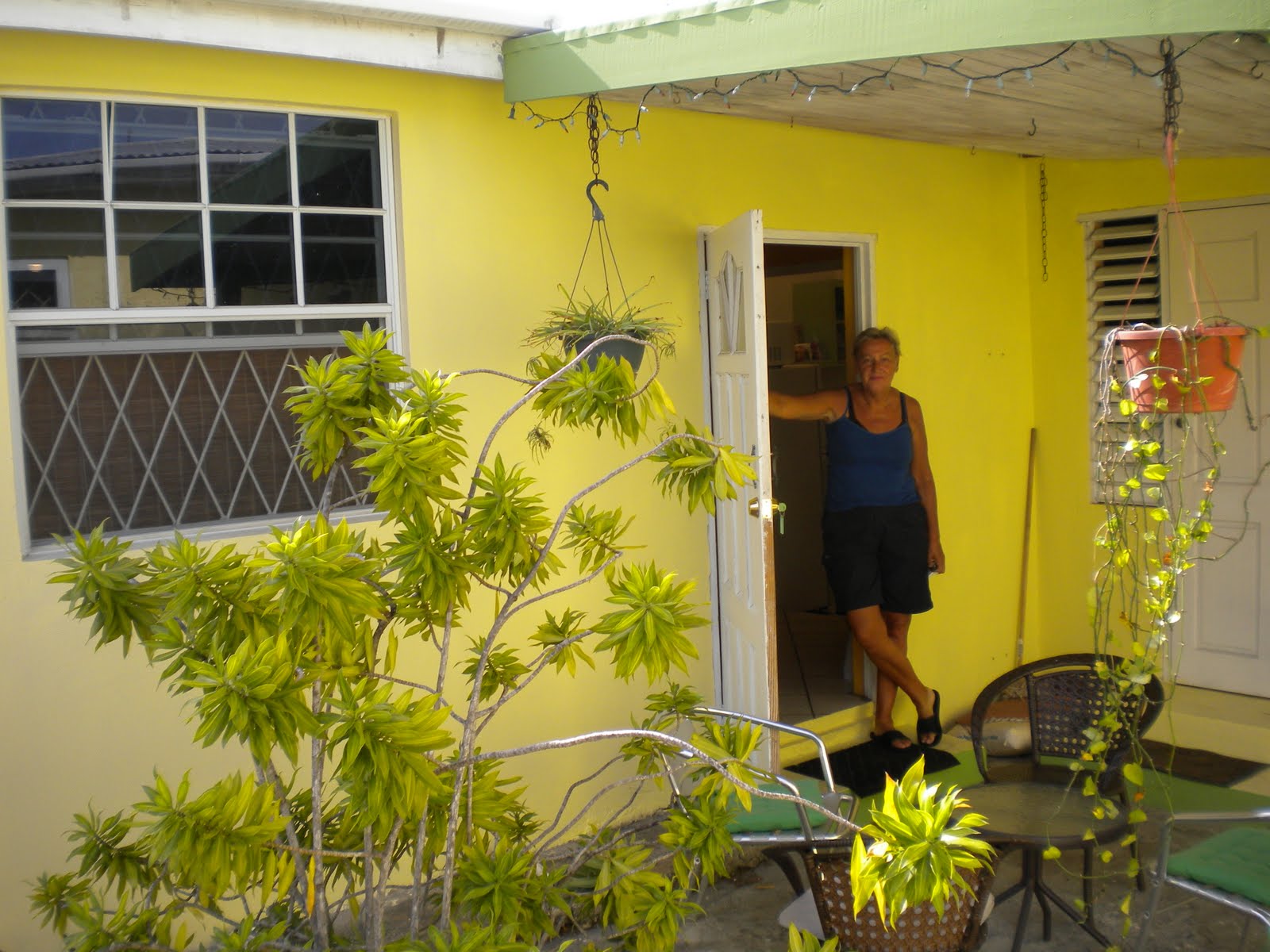
Outside the cottage
View towards Oistins:
The local beach:


which proved to be our favourite of all beaches we visited.  It was used mainly by local Bajuns and wasn't infested with plastic sunbeds..


This is Crane beach (voted one of the world's top ten!).  But the waves were too wild for swimming, there was no natural shade, and it had lots of tourists.


For the arrival of Anna and Kaz, we hired a little mini-moke:


and much amusement was had watching the parents leap (?) into the doorless vehicle.   This meant we could see a good bit of the island. Though the local buses are very cheap - 66p for any length of journey - they were less flexible for more distant locations.


So, sandcastles were built:
death defying ball runs constructed:
and beers consumed:


We all then caught the LIAT airlines flight for the short journey to Cheddi Jagan airport, Georgetown. Unfortunately, Kaz's luggage - with his clothes, binoculars, computer parts, Marmite and other vital UK supplies - did not leave Barbados with us. The next 24 hours were spent in a state of some anxiety, awaiting the bag's eventual safe delivery, delaying any sight seeing as all the following day it was due to arrive (in the Guyanese phrase) "just now".  Score 2-0 to the airlines.


The rest of Easter weekend was spent in Georgetown visiting the Botanic Gardens


and like everyone else in Guyana, flying our kite.


We then started on our long awaited trip to Guyana's remote Rupununi Savannah in Region 9, to stay in eco-lodges, see Amerindian villages and hopefully spot some of the exotic wildlife. The journey to Region 9 can be made by a small, crowded mini-bus, taking anywhere between 11 and 22 hours, travelling at high speed on the largely unpaved road - so we decided to fly! 


The Trans Guyana Airlines (TGA) ticket, website and leaflet all said that the departure time was 10.30am on Easter Monday. Staff at our first lodge - who would meet us off the plane at Annai airstrip - emailed that they would meet us from a flight that left at 7.30am - so we checked to find that TGA had indeed changed the departure time to 3 hours earlier, though no one had thought to let us know.  3-0 to the airlines -  but we did manage to catch the plane.


We had thought we were staying in the annex to Rock View Lodge, but Colin Edwards, the charismatic, ex-VSO owner, met us off the plane and insisted we stay at the main lodge.  View from our apartment:
On the veranda:


A nearby village, Surama, was inaugurating their new airstrip, so we were invited to go to the ceremony.  Eventually, we went off  ("just now"), to be passed on the track by all the other invitees returning ...  Never mind, we arrived in time to see the volleyball match and share a few beers with the villagers.  Kaz joined in.


On returning to Rock View Lodge, Halina found that she knew one of the guests.  Kaz and Anna are used to their mother constantly meeting people she knows in Bristol, but in the Guyanese interior?


Rock View has a well-constructed "panorama walk" and we climbed it next morning.  From the top you get fantastic views of the huge Rupununi savanah:


The red line is the main but as yet unpaved road from Georgetown to Lethem (and Brazil).


To see and climb hills after 8 months in super flat Georgetown was amazing.  


We went to see some burrowing owls - they could only be seen through a telescope:


On the way back, Gabriel, the guide, spotted a spider monkey.


Next up was a journey by jeep to Ginep Landing on the Rupununi River to make the two hour boat journey to Karanambu Lodge.  On the way, we disturbed a rather large black caiman sunning himself on the bank:


He soon slid off into the river and vanished.


At Karanambu Lodge, we were welcomed by Andrea and Salvador, together with Diane McTurk who owns the former cattle ranch and is well known for her work rescuing giant river otters.  See this link for an article about Diane: http://savingotters.wildlifedirect.org/tag/karanambu-ranch/

Whilst having lunch, one of the staff came to say a snake had caught a bird in the tree outside, so we watched as the still fluttering bird was ever so slowly turned into a snakey bump.


Nature eh!?


There were no giant otters at the ranch while we were there but we did go out in the evening with Salvador to a nearby lake to see the giant Victoria Amazonica lilies.  The lake was accessed through a tunnel of trees off the river, then we were in a sea of enormous lily pads:


We then settled down to watch the flowers slowly open as the light faded, with the welcome addition of some of Diane's famous rum punch and biscuits.


Magical!         


Next day it was up at dawn to search for a giant anteater out on the savannah. Just when it appeared that we'd be unsuccessful, one was spotted in the distance and two of the guides ran off to herd it towards the truck.  Sure enough, a little while later it came trotting towards us:


What a sight!


That evening, we went out again on the river with Diane and watched spellbound as the bats and lesser nighthawks swooped about in the twilight catching insects.  Go nighthawks! you can't eat enough of them.  The local menace is the kabura fly whose bite really itches for days.  Halina's ankles will vouchsafe this.  More rum punches and cakes, then a gentle return for supper.


Kaz had a surprise when getting ready for bed; moments after he'd used the washbasin, a snake eased its way out of the sink overflow!  Anna was dispatched to get help - "Salvador, snake!" - and Salvador caught the offender, "only mildly venomous", and returned it to the bush.  The bats in our ceiling seemed small beer by comparison (but did they have to poo everywhere?).


Next day we took our leave of the lovely people at Karanambu:


and we transferred by boat to Caiman House, further up the Rupununi River. The big attraction here is their night-time caiman catching, but sadly the river had risen nearly 12 feet in the last few days which meant no caiman catching.  We did go out in the evening though, in the large dugout canoe:


and sailed quietly along seeing brown capuchin monkeys, river bats, numerous species of birds and lots of caiman eyes.


Caiman House is in the Amerindian village of Yupucari. We stayed in the lovely guest house:


near to the library.


which is part of Caiman House's brilliant project - Rupununi Learners. More about this on http://www.rupununilearners.org  Mike, the staff and guides are great hosts and very knowledgeable about the savanah and its flora and fauna. Caiman House also hosts other researchers. During our visit, the researcher on river turtles had a hatching:


Leaving Caiman House and the Rupununi proved more difficult than we imagined. We had arranged to be picked up by Trans Guyana Airlines (TGA) at Karanambu airstrip, a bumpy, 45 minute drive from Caiman House. The Georgetown to Lethem flight can, if booked, make two stops at Annai and Karanambu to pick up or put down passengers, either inbound or outbound, and communicates by email with the lodges to let passengers know the pick-up time. No phones out here, and most villages still rely on radio communication.


We arrived at the appointed time to find that our plane had already been and gone - a change of routing without informing customers.  4-0 to the airlines 


We bumped along back to Caiman House, and were told by email that TGA had sold our seats in Lethem but the only other plane out that day had four seats if we could get to the airstrip on time to meet it. We raced out to the airstrip and...


we saw no planes, though this must count as one of the best views from an airport waiting "lounge".  5-0 to the airlines.


Caiman House kindly accommodated us for another night, and all the local lodges then began asking their guests to swap flights to secure us seats on a plane to Georgetown before Kaz and Anna were due to fly back to the UK  - in 2 days time. TGA were saying they had no seats for at least 3 days... 6-0. 


Later, TGA offered one seat on the next day followed by three seats the day after.  We accepted with the thought that Halina could return to Georgetown first as she needed her medicines.  The next morning, we went again to the Karanambu airstrip but we took all our luggage with us ... just in case.  A plane arrived - our first in three visits to the airstrip!  - with  only one passenger aboard, who was visiting Karanambu Lodge. All those empty seats - but it was headed outbound to Lethem.  Andrea and Salvador had come down and together with Mike from Caiman House, persuaded the pilot to take us all to Lethem.  After an anxious wait at Lethem airstrip, the pilot managed to get us seats on his trip back to Georgetown, which we delightedly accepted, so we returned only 24 hours later then scheduled.  6-1.


A little more sightseeing in Georgetown and it was time for Kaz and Anna to get the early LIAT flight back to Barbados, with an 8 hour wait for their connection to Gatwick and a cunning plan to escape to the nearest beach for a last few hours of sea and sun. The LIAT flight took off on time - but landed 5 minutes later back in Georgetown. The initial small technical hitch became a large one - and Kaz and Anna were stranded yet again. 


LIAT said that it would get them on a Caribbean Airways flight leaving soon (it didn't), would get them some breakfast (it didn't), get them on another LIAT flight going at mid-day (there wasn't one) and get them on an afternoon LIAT flight (which left too late to connect with their BA flight to the UK). However, as they landed in Barbados, there was the BA plane, also running late, so after a quick dash across the tarmac, they were at last on a plane to England. Their luggage though - house keys, phones and warm clothes - stayed in Barbados for several more days. Probably 7-1 to the airlines by now.


During our exciting week in the Rupununi, Guyana was hosting a major conference on...Sustainable Tourism. Despite all our plane problems, we would encourage people to visit the interior of Guyana. The people, the wildlife and scenery are amazing, and we are all still smiling.


A belated happy Easter!


Sunday, 19 February 2012

Working in Guyana

Some people have asked what we actually do in our volunteer work here in Guyana - this needs a bit of background about the country to make sense.

Halina's VSO post is as an Organisational Development Advisor with Guyana Community Based Rehabilitation Programme (GCBRP), a long established voluntary organisation that trains volunteers to support persons with disabilities in their communities as well as campaigning for disability rights. It is one of the few organisations trying to operate across the whole few country - most other voluntary groups are Georgetown focused.


DPN Region 2 Committee meeting
A couple of years ago, six GCBRP regional groups established themselves as autonomous organisations - Disabled Peoples Networks (DPNs).  Halina's job is to assist both GCBRP as a whole and the regional DPNs to achieve their goals and become more sustainable organisations. 


The GCBR team at a leaving event for a VSO colleague.
Steve has come as a "supporting partner" in VSO terms, but is in great demand for his ability and willingness to mend, sort out and set up computers and other bits of office equipment, to help people to use computer programmes in their work, and to deal with numerous computer glitches that affect almost everyone from time to time. In fact, Steve is so often in Halina's office that he has become an integral part of the team!


Guyana is a big country with a small population of 760,000 people, who mostly live in the capital city, Georgetown or along the Atlantic coastal strip.  The country’s history means that there is a rich diversity of residents with African, East Indian, Chinese and Portuguese origins, alongside the ten remaining native Amerindian groups.

Catching the speedboat on the way to a meeting
80% of the country is pristine rainforest, and there are few surfaced roads. Guyana's many rivers are both great transport routes and real barriers to getting around. There are only two bridges across the river mouths flowing into the Atlantic - the Demerara and the Berbice bridges - so travelling to the more remote regions involves exciting speed boat journeys, often in the driving rain.


Lots of people continue to leave the country in search of a better life. There are more Guyanese living in New York and Toronto than in the whole of Guyana! Emigrants are mainly professionals with higher education, which means that those unable to leave - persons with disabilities, older people, unskilled workers - become a bigger proportion of the population as a whole. Though many residents are supported by family earnings from abroad, this Moneygram culture distorts the economy, making some prices very expensive compared to earnings.


Gold mining in the rain forest
Guyana's economy still largely relies on mining, agriculture and forestry - sugar, rice, timber and shrimps are the major products. Bauxite mining has declined, but there is a now a gold rush underway. "Pork knockers" - miners - are to be found in the many small scale mining operations scarring the rainforest and riverbanks.  Large ex-army trucks carrying mining equipment are everywhere, covered in the red dust of unmade tracks that comprise most of the road system in Guyana. A Canadian company is undertaking oil exploration. Then there is the grey economy - the illicit drug smuggling made easy with the long (empty) borders and coastlines - and, it is said, a high degree of corruption.

Timber is plentiful, though we are not sure how much is being managed in a sustainable way. The Iwokrama Rainforest Project and Conservation International are both active here. There is a plan to get Western nations to sponsor parts of the rainforest to preserve it, with all its amazing bio-diversity, though only Norway has signed up to the scheme so far. Eco-tourism is in its infancy, and visits to see the natural wonders of Guyana are incredibly expensive and immensely difficult to organise.

So... there is poverty here in the midst of wealth, little manufacturing or processing (almost everything for sale in the many shops and stalls comes into the country in containers from China) and a constant loss of skilled people. There is also a high crime rate (see previous blogs) and poor infrastructure - no drinkable  tap water, regular power cuts and rubbish everywhere, mostly plastic bottles and packaging.


Grace from DPN Region 4 East Coast Demerara
Persons with disabilities are some of the poorest people in Guyana. It is hard to imagine the daily hardships of some of the people that I work with, who remain amazingly cheerful and optimistic. Most are unemployed, many have had little schooling - people still hide their children with disabilities at home, and schools have few special needs facilities or teachers - and all live on small incomes - benefits are insufficient to buy enough food, let alone pay for independent housing, transport or care. It was only in 2010 that Guyana finally passed its first ever legislation on disability rights - but there are no extra resources to provide for any accessible buildings, facilities or transport.


One of the few purpose built regional centres for persons with disabilities, now in need of modernisation

Members of DPN Region 5

I arrived at a time of change for Guyana Community Based Rehabilitation Programme. All of its long term aid from Western donors was coming to an end, and some of its original services - training volunteers to provide community based rehabilitation  -  had been picked up by the  Ministry of Health. So...there was a need both to rethink its priorities, and to attract a more mixed income stream from more local, in-country supporters and investors. 


For the Disabled Persons Networks, there was a mixed picture -  some groups were developing quickly with capable leaders whilst others were struggling. The National Disabled Persons Network existed in name only - it had a committee but no funds so had never met and could not support it's regional groups.


I have worked with GCBRP to help them develop a new Strategic Plan (including proposals to deliver more vocational training and employment support services), researched and contacted potential funders, and written a number of funding bids for both GCBRP and the Disabled Persons Networks. One small bid has been successful, and we are waiting to hear about the rest. 


Meeting of DPN Region 5 members and the President(far right)
I am also working with groups to improve their networks and partnerships, and to help them lobby and campaign better. Recently, this has involved some exciting meetings with senior decision makers, including the newly elected President of Guyana, Donald Ramotar, the Mayor of Georgetown, Mr Hamilton Green, and the First Lady, Mrs Deolatchmee Ramotar.

The Mayor (first left), Mrs Geraldine Halls and a Canadian VSO.
Mrs Ramotar is in the grey trouser suit. The photo includes GCBRP staff,  volunteers and committee members.  


We are hoping that Mrs Ramotar will become a sponsor of the organisation and help us make contact with business leaders in Georgetown.


We have now completed six months of our placement and there seems more to do than ever!  


If one of the major bids for funds is successful then I will feel my time here has been a well worth while ... and there will be serious amounts of Organisational Development Advice required!


Saturday, 21 January 2012

Christmas blues

We send belated Christmas greetings and our wishes for a happy and peaceful new year to everyone. 


During the Christmas period, we experienced some real highs and lows. We had some good times, listening to the choir in Georgetown Cathedral, and joining the throngs of shoppers in Georgetown in the fierce heat and terrific thunderstorms – the winter rainy season here is known as the cashew rains.

Georgetown was filled with giant inflatable Santas, reindeers and fake snow – has anyone here actually seen snow? -  and the music blasting out of shops, bars, buses and the street CD sellers mixed in “White Christmas” with the latest soca and chutney hits, like "Rum is not me lover".  


We spent Christmas day itself visiting an old people’s home with other volunteers:

The volunteer crew: Fiona, Tessa, Janice, Drew and Steve. Rohan joined us at the home.

We gave out some gifts bought with funds donated by volunteers and their friends:


Then we sang some carols and had some of the inevitable Guyanese speeches:


We then moved on to the Red Cross Children's Home nearby and presented them with a selection of books:


We had a go at reading to the children, then went outside to play with some very lively toddlers!


Or not so lively!

In the evening, we hosted the pot luck Christmas supper:


We were joined by our Dutch VSO colleagues, Selina and Anna:


and by Susan and Nick  from the UK.

We played some games and had one or two seasonal drinks.

The lows during the Christmas period came in the form of illness...
Halina had Dengue fever - which meant she spent 40 hours in bed with terrible pains in her joints. Steve had somehow picked up a jigger (burrowing insect) from our Kaieteur trip that had infected his foot and he had to have an operation at the Mercy hospital (under local anaesthetic) to have it removed. 

...thefts...
On the day before he was due to go for the operation, Steve’s bike was stolen from our yard - the thieves cut through the razor wired fence.

The bike in happier (though wetter) times, safely locked to the fence post:


Then on Christmas Eve, while we were both in the flat cooking up a storm for Christmas Day, a sneak thief came into the flat and stole a bag, purse, money and our travel mosquito nets.

..and invasions!
Having successfully defeated the cockroaches and mice, we had found that rats were coming into the kitchen and eating our home made bread.

We thank all our lovely new friends and work colleagues in Guyana who have helped us through  some tricky times. We have had cake, the loan of a bike and lots of support. 


Halina is back at work and will write soon about what she has been up to in her volunteer placement.